
Floats and Frames
Modular Pontoon Solutions
 pontoon-moorings-jetties-marinas-uk.jpg
Our moorings, jetties, floating docks and marina networks are built from a slot-together catalogue of modular pontoon assemblies: spine pontoons that link end-to-end into walkway runs, single-float finger berths that bolt to the spine at three rake angles, and articulated gangplanks that land ashore on fixed plinths. Every module uses the same Cutlass Marine rotomoulded floats and single-piece fabricated marine-grade aluminium frames proven across our floating-home bases, and everything is drafted, fabricated and finished in-house in Poole, Dorset.
Everything end-to-end is ready to fit with just spanners: the articulated axle joints come pre-assembled, and connecting spine to spine — or landing a gangplank on a spine end — is simply a matter of slotting the axle tube through and capping either end. Broadside attachments work differently: finger berths, 90° branches and broadside-mounted gangplanks each mount on a bolt-on nog kit that can be drilled to fit wherever you choose, so berth positions and branch points are entirely yours to set. One connection standard runs through the entire catalogue, so a private end-of-garden mooring and a multi-berth marina network are built from exactly the same parts, and every layout can grow or reconfigure later.
This is a kit — but a genuinely simple one. Every module frame is a single fabricated piece of marine-grade aluminium hollow section and joists, ready to accept its pre-cut GRP marina mesh deck boards: anti-slip, corrosion-proof and low-maintenance, they fix down to the aluminium once the module is launched and are finished with angle trim along the long edges. The system is designed to be comfortably assembled by a couple of people, from an end-of-garden mooring to a full marina or infrastructure install — and if you would rather we did it, installation by our team is available.
The same catalogue builds floating seating areas and extra covers for waterside pubs and restaurants, private end-of-garden moorings, lake swimming platforms, tidal boat tie-up points, full linear river moorings and marina finger-mooring networks. It handles saltwater and freshwater alike, rides significant rise and fall in flood or tide, and is comfortable beaching out. Explore the modules below, then design your own layout in the live Mooring & Marina Builder, or talk to us about siting, anchoring and optimising a mooring kit for your stretch of water.
Prefer to talk it through first? Send us your site, span and use — we design mooring and marina layouts directly with you and turn a drawing and quotation around quickly.
 mmb/mmb-tri.jpg
 mmb/mmb-cat.jpg
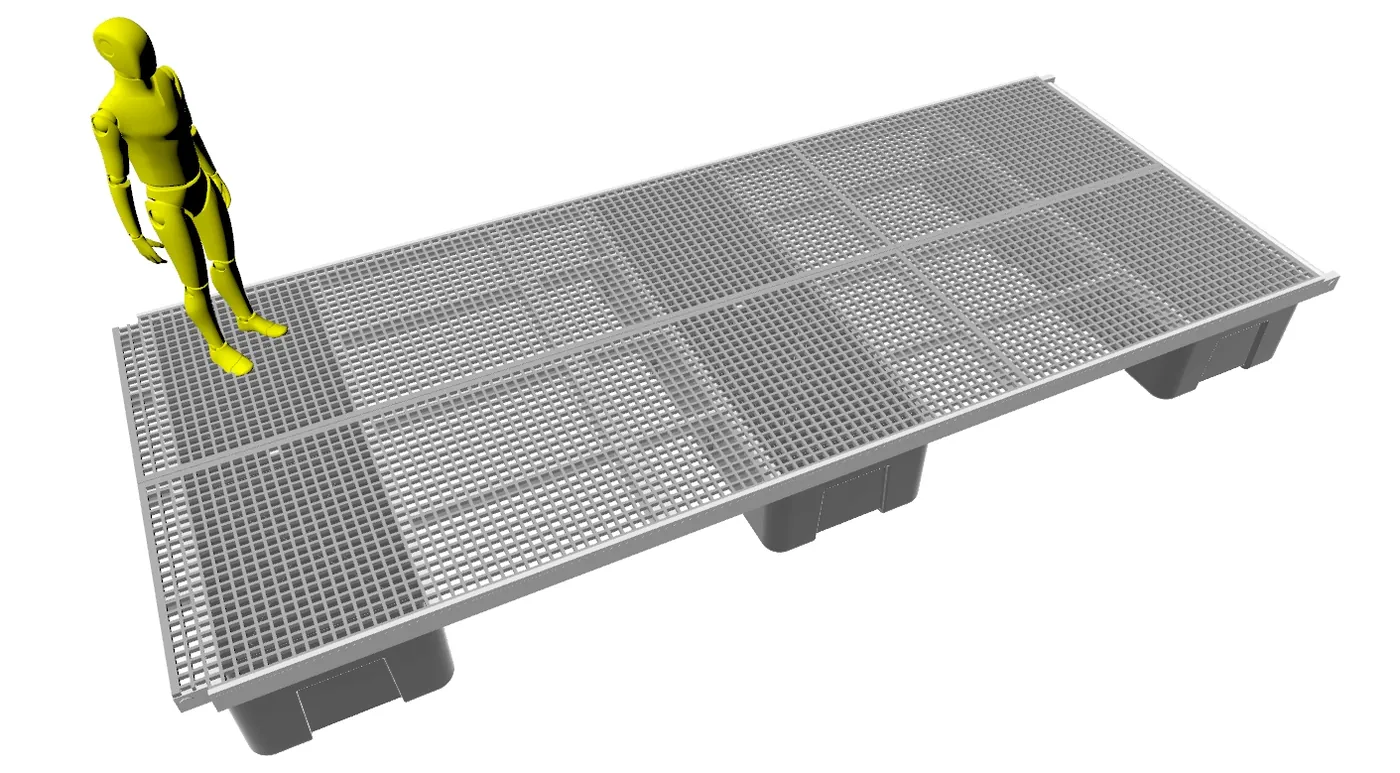
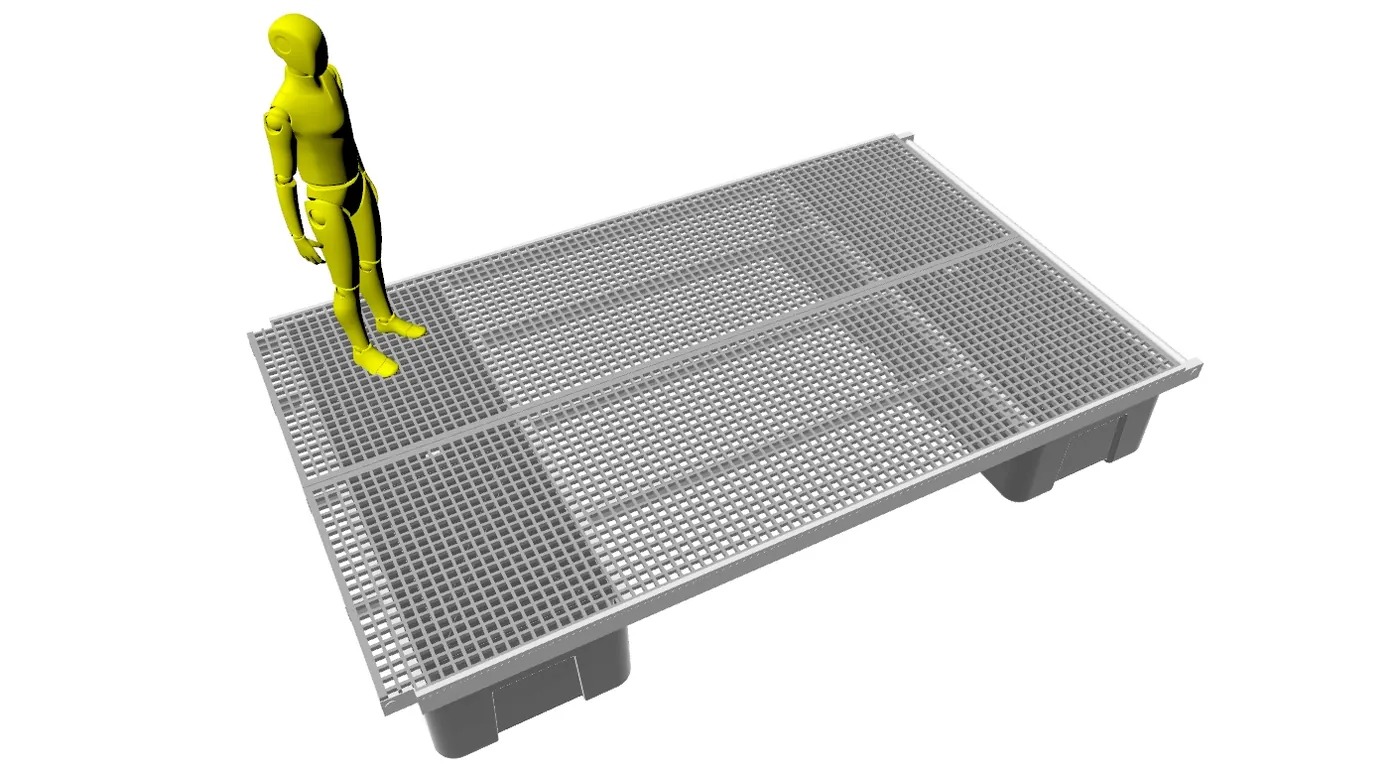
Spine pontoons are the backbone of every layout: fully decked, walkable modules that link end-to-end into runs of any length. The trimaran spine (6.130 × 2.503 m, three Cutlass-series floats) is the long workhorse; the catamaran spine (4.183 × 2.503 m, two floats) is its shorter sibling. The two are fully interchangeable — mix them freely in one run to hit the length your site needs.
Each module is a single fabricated piece of aluminium hollow section and joists that slots over its floats, with pre-cut GRP deck boards fixing down once it is afloat. The articulated axle joints at either end come pre-assembled — slot the tube through, cap it off, and module joins module with just spanners into a smooth linkage that lets a long run follow tide, wake and flood without stressing the structure. On the broadside, bolt-on nog kits take finger berths, gangplank assemblies, a 90° branch to turn a corner, or a second spine locked flush alongside — drilled to fit wherever your layout wants them.
Typical applications: marina walkways and access pontoons, jetty spines, floating boardwalks, and the backbone of every finger-mooring network.
 mmb/mmb-fin-90.jpg
 mmb/mmb-fin-45.jpg
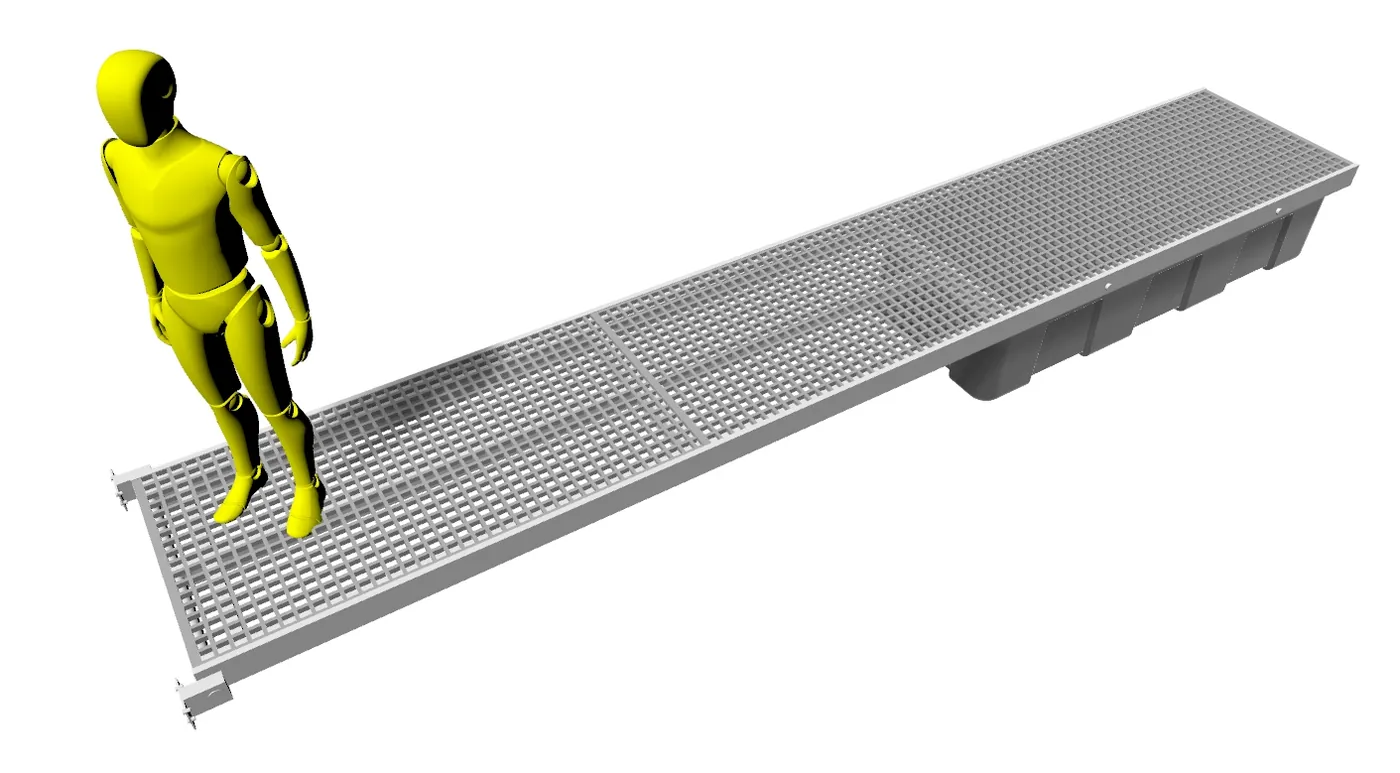
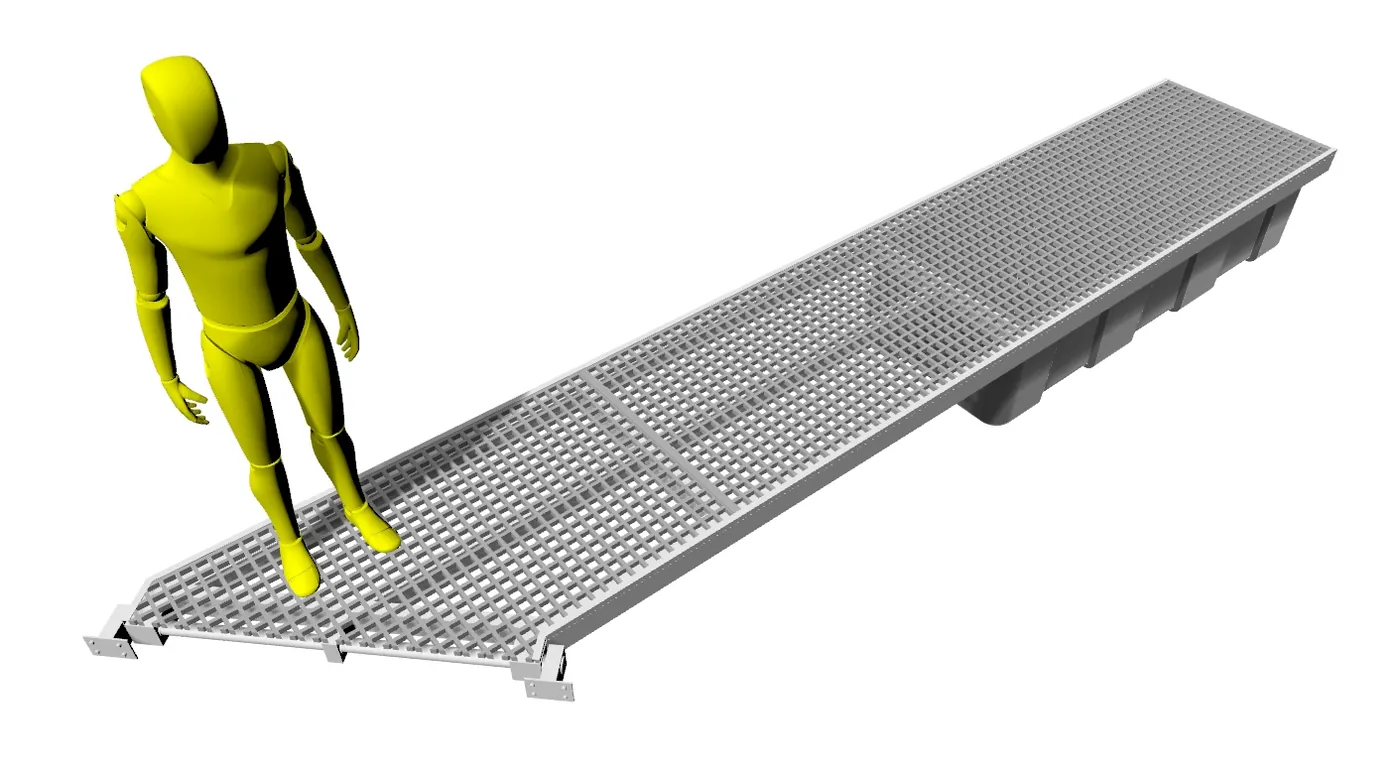
Finger berths turn a spine run into moorings. Each is a single-float finger on a fabricated aluminium ladder frame with a six-metre berth run, mounting to the spine broadside on its own bolt-on nog kit — drilled to fit at whatever position your berth widths need. Plan it in the builder first: drag the fingers live along the spine and read the boat gap between them straight off the measuring chains, then drill the kits to match.
Three rakes cover every berthing pattern: a square 90° for conventional side-on berths, and 25° or 45° rakes that angle the berths along the spine for tighter fairways and easier approaches. Raked fingers simply flip over for the opposite hand — the same product either way up, so a herringbone marina uses just one part number per rake.
Typical applications: marina finger networks, yacht and motor-cruiser berths, tender and day-boat moorings, canoe and paddle-sport docks.
 mmb/mmb-gang-dw-L.jpg
 mmb/mmb-gang-sw-S.jpg
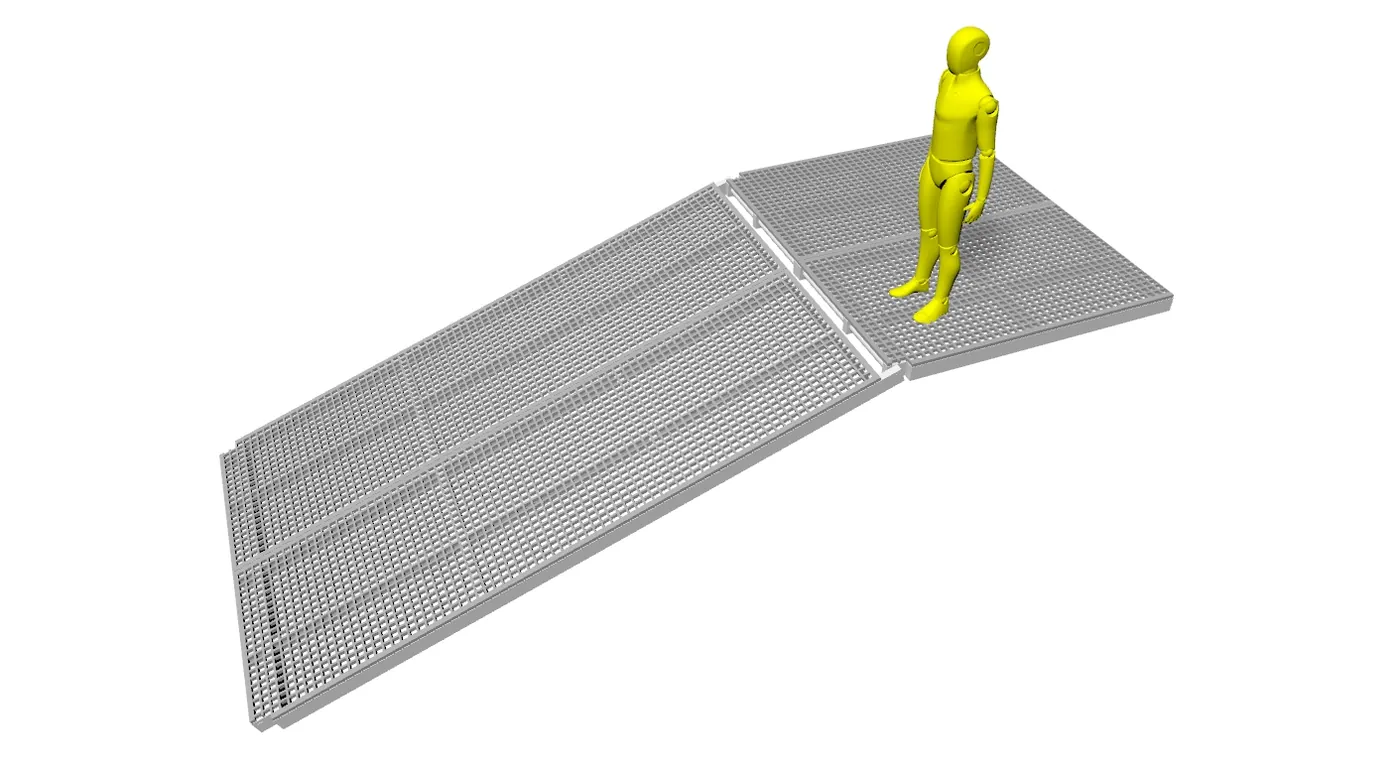
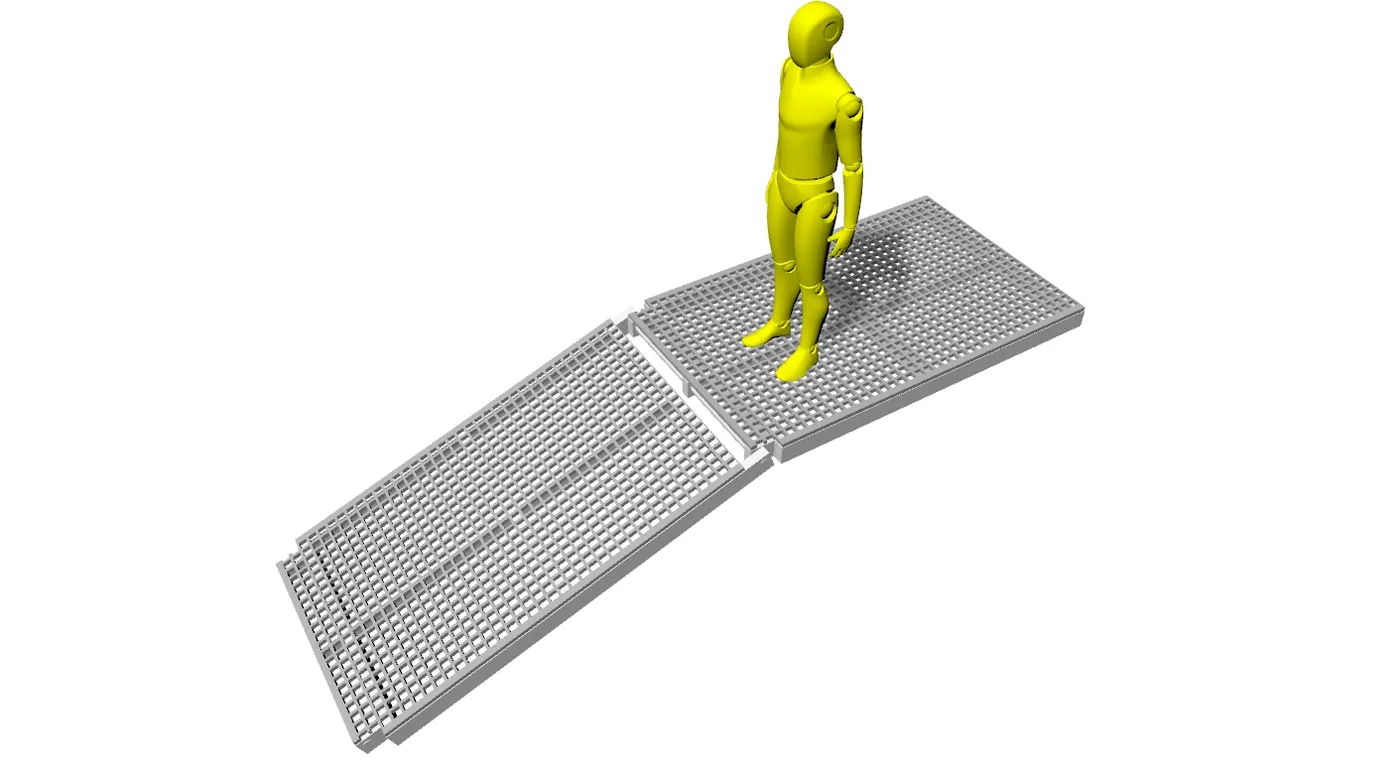
Every layout comes ashore over an articulated gangplank — a single-piece fabricated aluminium frame supplied with its pre-cut GRP mesh deck, all fixings and side trim, hinged to the pontoon on an articulated axle. Two lengths (2.158 m and 4.183 m) and two widths (2.503 m full-width and 1.253 m walkway-width) cover everything from a compact garden mooring to a marina access ramp — fitting straight onto a spine end with spanners, or onto a broadside with a bolt-on kit drilled where you need it.
Shore attachment uses our fixed-plinth methodology: a width-matched top plinth ships with every gangplank and sets on dry land with ground screws, masonry fixings or similar — no piles and no in-water fixings for your shore access. The result is a flood-resilient articulated landing: the pontoon rises and falls with the water and only the gangplank's slope changes, so access stays usable through tide, spate and seasonal level swing. The plinth's hinge line is your bankline — in the builder you place it right on your bank and design outward from there. And because every fixing stays on dry land, there is nothing to set in the river or lake bed — which typically keeps consenting far simpler and takes real cost out of the install compared to piling.
Typical applications: bank access for every mooring and jetty, tidal and flood-prone landings, accessible walkway entries.
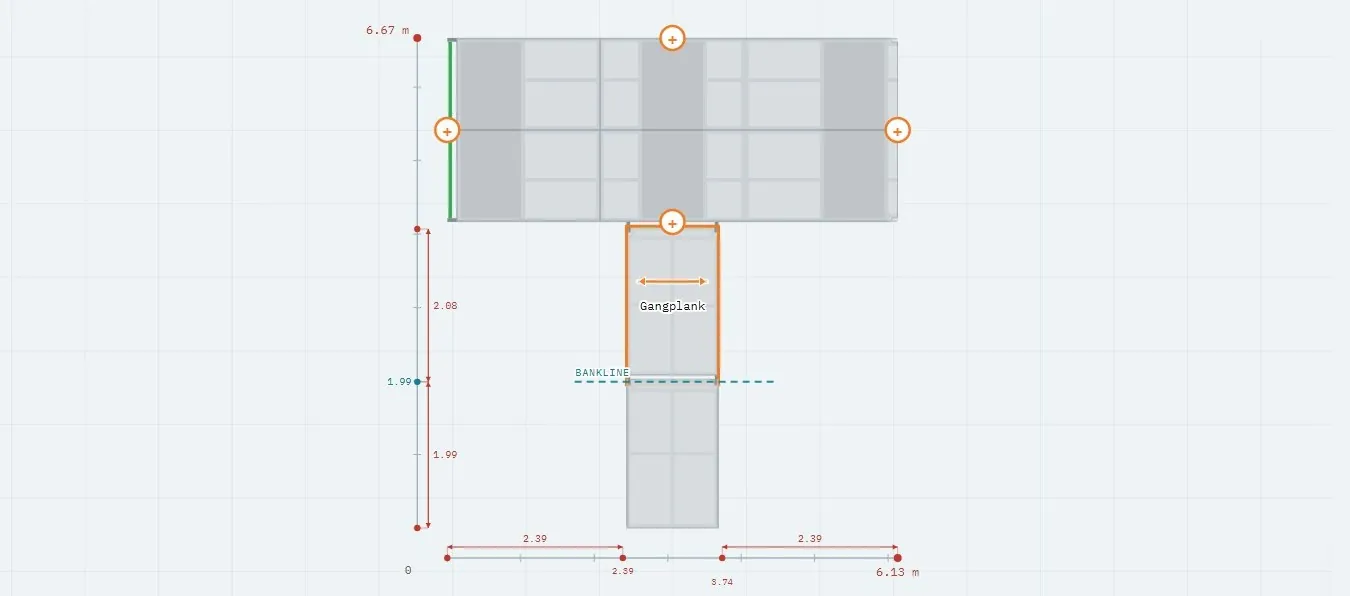
Because every module shares one connection standard, layouts scale without redesign. An end-of-garden mooring is a spine, a gangplank and a plinth. Add fingers and it berths a second boat. Extend the spine, branch it at 90°, pair spines alongside for a wider promenade, and the same parts become a jetty network or a full herringbone marina — and any layout can be reconfigured, extended or relocated later, because nothing is welded and nothing is cast in.
 mmb/mmb-array-mooring.jpg
One spine pontoon, one gangplank, one plinth on the bank. Berth alongside the spine, or add a single finger for a second craft. Comfortably assembled by two people in a day on most sites.
 mmb/mmb-array-marina.jpg
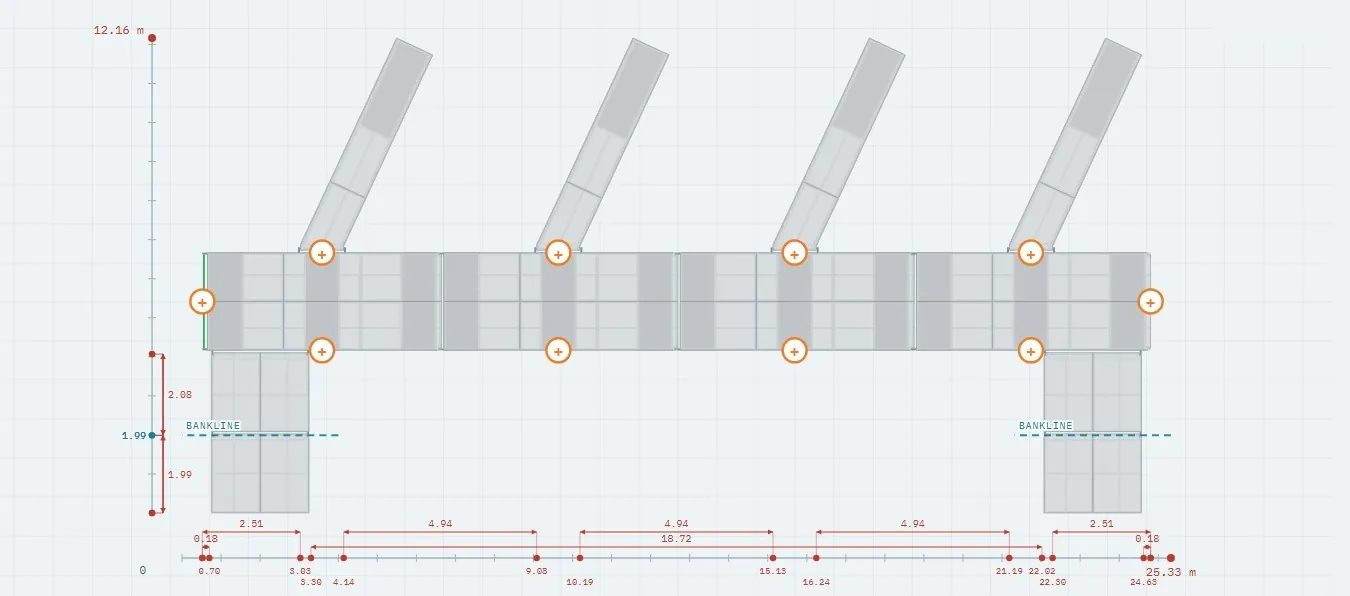
Spine runs joined end-to-end and branched at 90°, fingers at your chosen rake and spacing down each side, gangplanks landing wherever the bank allows. Designed berth-by-berth in the builder.
| Module | Envelope | Floats | Connects by | Role |
|---|---|---|---|---|
| Trimaran spine | 6.130 × 2.503 m | 3 × Cutlass series | Pre-assembled axle joints both ends; broadside bolt-on kits | Walkway backbone, long runs |
| Catamaran spine | 4.183 × 2.503 m | 2 × Cutlass series | Pre-assembled axle joints both ends; broadside bolt-on kits | Shorter runs, length fine-tuning |
| Mono finger berth | 6 m berth run · 90°/25°/45° | 1 × Cutlass series | Bolt-on broadside kit, drilled to position | Berthing off any spine |
| Gangplank | 2.158 / 4.183 × 2.503 / 1.253 m | — (spans to shore) | Articulated axle to spine end or broadside | Bank access |
| Top plinth | Width-matched, included | — (sits on the bank) | Articulated axle to its gangplank | Fixed shore anchor point |
Spines make the structure, fingers make the berths, gangplanks and plinths make the landing. The two spines are interchangeable, so runs are built to length by mixing them; fingers set berth widths at any position along a spine face; and the gangplank's plinth fixes the whole layout to the bank without in-water works. Every articulated joint carries exactly one axle tube by construction, so any module can meet any other, either way round. This catalogue is our most common, budget-efficient set, refined over years of waterside builds rather than a definitive list — alternative joist layouts for composite or plank decking, longer spans and higher-buoyancy float units are all regular work.
Every Floats and Frames pontoon pairs with a full range of mooring, access and safety accessories, fabricated in-house and supplied ready to bolt on. Below are the families we supply most often — and like the modules themselves, they are common options rather than a definitive list; handrails, swimming ladders, piling and similar options are all available, and bespoke fittings are always welcome.
Every mooring module is supplied with pre-cut GRP marina mesh boards as standard — and the frames take other surfaces where the project calls for them.
Shore access never needs in-water fixings — but larger or more exposed layouts can be held on station in whichever way the site demands.
A full range of fittings completes your floating infrastructure, pre-installed or supplied as a bolt-on retrofit kit.
Because everything is made in-house, bespoke fittings are always welcome, from a non-standard gangway span to a unique mooring solution.
Floating seating areas and covers for waterside pubs and restaurants, private end-of-garden moorings, lake swimming platforms, tidal boat tie-up points, full linear river moorings, marina finger-mooring networks, floating walkways and boardwalks — in saltwater or freshwater. Every layout is configured from the same catalogue — spine pontoons, mono finger berths at three rakes, gangplanks and shore plinths — so one system covers a single private berth through to a full marina network.
End-to-end, everything is ready to fit with just spanners: the articulated axle joints come pre-assembled, so joining modules is a matter of slotting the axle tube through and capping either end. Broadside attachments — finger berths, 90° branches, broadside gangplanks — mount on bolt-on nog kits that are drilled to fit wherever you choose. One connection standard runs through the whole catalogue and every articulated joint carries exactly one axle tube by construction, so any module meets any other — and layouts can be extended, rearranged or relocated later.
Through our fixed-plinth shore strategy: a width-matched top plinth ships with every gangplank and sets on dry land with ground screws, masonry fixings or similar — no piles and no in-water fixings for your shore access. The articulated joint lets the pontoon rise and fall with water levels while the plinth stays put; only the gangplank's slope changes. Keeping all the groundwork on dry land also typically keeps consenting far simpler — and takes real cost out of the install — compared to setting piles in the river or lake bed.
Yes — and in saltwater as well as freshwater. Articulated axle joints let linked modules move smoothly across significant tidal and flood ranges, the modules are comfortable beaching out on a falling tide, and the fixed-plinth gangplank keeps bank access usable through the level change. For exposed or commercial sites, pile-and-roller guidance holds the structure on station while it travels vertically. Tell us your water type and level range and we will advise the most robust arrangement.
Finger berths slide along the spine faces, so berth widths are whatever your craft need. The easiest way to plan them is the Mooring & Marina Builder: drag the fingers along the spine and the measuring chains show every berth width and spacing live on the plan, along with distances from your bankline.
Pre-cut GRP marina mesh boards come as standard with every mooring module — anti-slip, corrosion-proof and low-maintenance, the usual specification for commercial and public pontoons. They fix down to the aluminium once the module is launched and finish with angle trim along the long edges. Alternative joist layouts for composite or plank decking, or frame-only supply for your own surface, are regular work — just say so in your enquiry.
Both. Everything is supplied as a self-assembly kit designed to be comfortably put together by a couple of people: frames arrive as single fabricated pieces, end joints slot together with spanners, broadside kits drill to fit where you set them, and the pre-cut deck boards fix down once the module is afloat. If you would rather we handled some or all of it, installation by our team is available — from an end-of-garden mooring to a full marina or infrastructure project.
Yes. We supply the pontoons, accessories and all fixings, and we advise on siting, anchoring methods and pile-setting for your water type and level range — send us your site details and we will guide the best approach for a durable, low-maintenance installation.
