

If you are planning a floating home, houseboat or pontoon, the hull decision shapes everything downstream: your draft, your maintenance calendar, your insurance conversation, how warm the boat is in February, and what happens on the bad day when something goes wrong. This guide compares the main options honestly: modular HDPE pontoon floats, the other pontoon systems on the market, steel monohulls and concrete hulls.
Declared bias, up front: we design and fabricate modular HDPE pontoon systems, so we are not neutral. What we can promise is fairness: steel and concrete get their genuine advantages stated properly, because a comparison that always concludes “buy ours” is a sales pitch wearing a lab coat, and you deserve better when you are choosing what your home floats on.
The comparison at a glance
| Modular HDPE float cells | Cylindrical / EPS-filled pontoons | Steel monohull | Concrete hull | |
|---|---|---|---|---|
| Buoyancy | Many independent sealed cells; one cell can be replaced alone | Fewer, larger units; EPS cores can waterlog over years | One hull volume; ballasted | One hull volume; mass-dominated |
| Failure mode | Localised: a damaged cell affects one cell, not the vessel | Skin breach sheds foam beads (EPS); cylinder loss is a bigger single event | Corrosion is gradual until it is not; a below-waterline breach floods the hull | Cracking and spalling with age; hidden rebar corrosion |
| Routine upkeep | Inspection via access caps; no coating cycle | Varies; inspect fixings and skin condition | Lift-out and blacking every few years; anodes; surveys with age | Crack monitoring; specialist repair when needed |
| Draft | Shallow and consistent | Deeper for the same load as cylinders immerse | Deep displacement | Deepest; heavy |
| Warmth & condensation | Air gap over water; no thermal bridge to the water, minimal condensation, no bilge | Similar principle, varies by build | Cold skin below waterline; condensation and bilge management are routine | Cold mass; condensation common |
| Transport & site access | Arrives in modules; assembled at the bank with spanners, no crane needed | Often craned as larger units | Heavy transport and crane | Very heavy; transport and craneage dominate cost |
| Adaptability later | Extend, reconfigure or re-trim by adding modules or ballast | Limited by unit sizes | Cut and weld: possible, costly | You are stuck with what you cast |
| Environmental notes | Single-material sealed mouldings; no foam fill; recyclable HDPE | EPS bead loss is a recognised marine litter problem; disposal is awkward | Coatings and anodes shed; recyclable steel | Inert in service; disposal is demolition |
Modular HDPE pontoon floats (what we make)
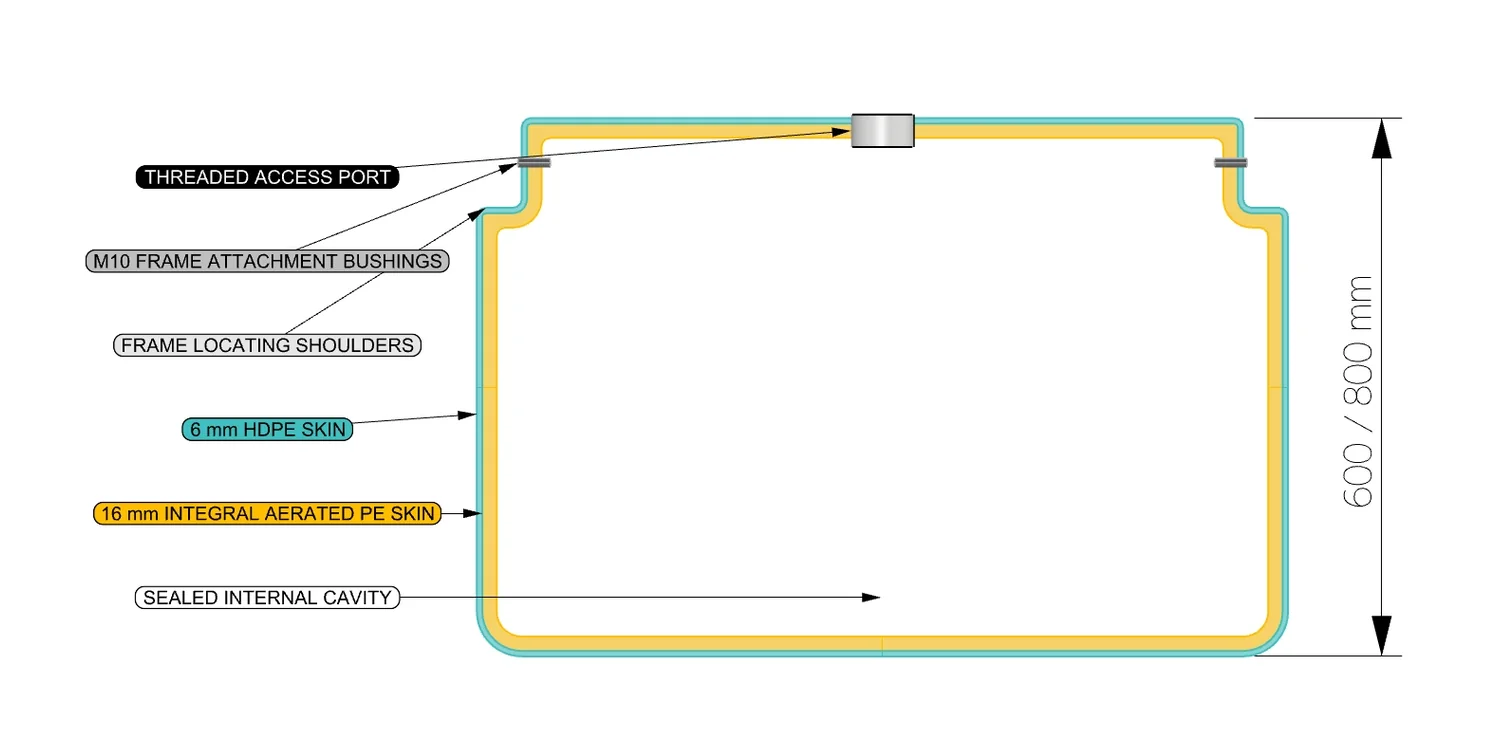 ✎ IMAGE SLOT · float cutaway or module diagram showing sealed cells, access cap, 16 mm foam lining on F variants
images/advice/hdpe-float-cutaway.jpg · 1495×739
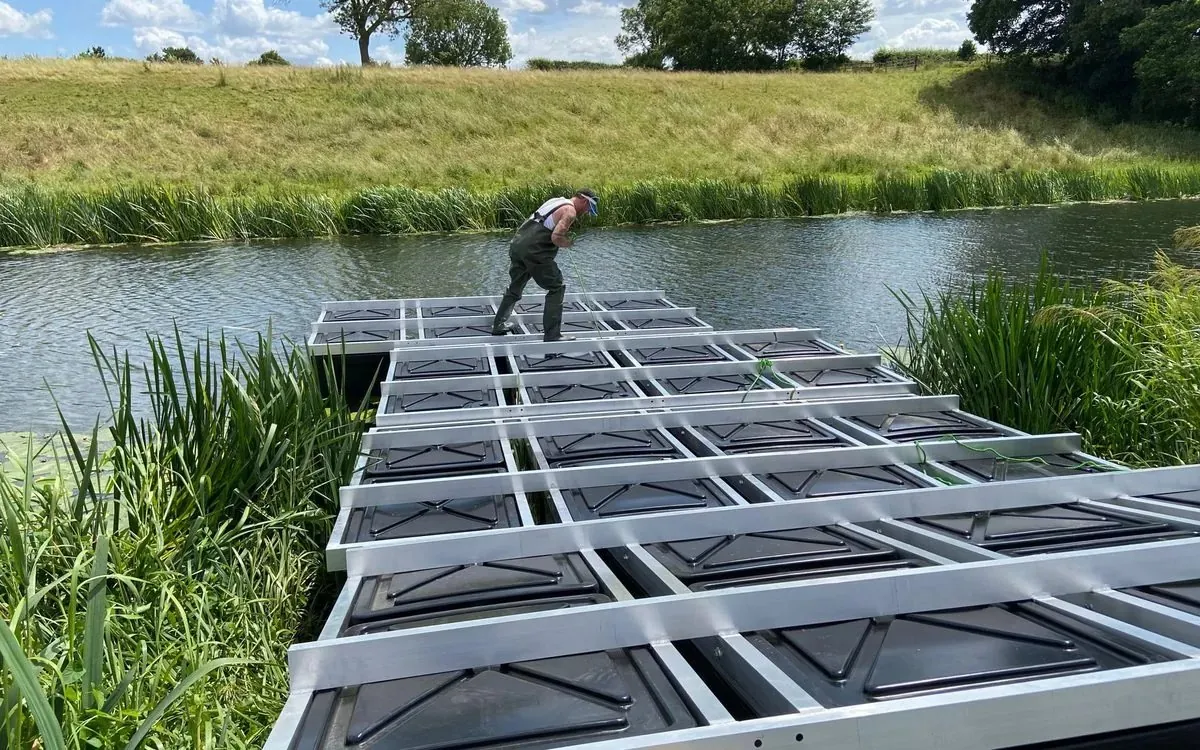
Our system floats a structure on runs of rectangular, individually sealed buoyancy cells: rotomoulded HDPE floats (sealed buoyancy tanks), carried in aluminium framing that never touches the water. Two of the float variants, the 400F and 600F, add a 16 mm integral lining of aerated polyethylene, moulded in the same single-piece process. That lining is nothing like a soft foam core: it is the same polymer as the watertight skin, foamed into a stiff structural layer that stiffens the float walls against oil-canning and deflection under hydrostatic pressure, which is what beaching, hardstanding and more aggressive environments actually demand of a hull. In roughly 15 years of supplying floats across saltwater marinas, navigable craft, tidal beaching vessels, pontoons, end-of-garden moorings and marina infrastructure, we have not had a float fail or take on water in service.
Why many cells beat one hull. A monohull is one big bet: the whole vessel shares one skin and one outcome. A cellular base spreads that bet across dozens of independent sealed volumes, so even the unlikely loss of a cell is a local event, and the response is to unbolt and replace one float, not to save a vessel. The same cellular layout brings quieter, everyday advantages:
- Trim and ballast control. Individual cells can take water or sand ballast to fine-tune trim, and cells can serve as water storage under the floor.
- Leaks drain overboard, not into a bilge. There is no sealed hull interior to fill: an internal water leak simply drains through the floor, over the floats and away. There is no bilge to pump and no hidden pool under the boards.
- Stability by shape. The floats' flat vertical faces act like hard chines in the water, resisting roll; the wide, rectangular footprint gives a confident, level deck.
- Warmth. The living space sits on an air gap above the water rather than on a skin in it, so there is no thermal bridge to the river, far less condensation, and none of the cold-floor damp that steel liveaboards manage all winter.
- Accessibility and low freeboard. No high gunnels to climb over: level access is natural to the format, which also makes genuinely accessible platforms straightforward.
- Grows with you. Rectangular modules bolt on: adding length, a terrace or a swim deck later is a planned operation, not a rebuild.
- No crane, no welding. Modules are assembled at a riverbank or finger mooring with spanners; there is no site welding, no power tools in the water and no heavy lift.
- Nothing metallic below the waterline. The aluminium framing sits above the water, protected from immersion; only the HDPE floats are wet, and HDPE is highly resistant to UV, solvents and oxidation. There is no coating to renew and no blacking cycle, and each cell is inspectable through its access cap.
- Two buoyancy densities, almost any footprint. Standard and deeper floats give a choice of buoyant capacity; beams are near-arbitrary and length is a matter of how many modules you connect.
The honest limitations. Rotomoulded HDPE tolerates knocks, abrasion and weather remarkably well, but it does not like sharp concentrated goring: a drill would go through a float wall quickly, and repeated beaching on sharp rocky ground calls for some judgement about the site. Pontoon craft also sit higher in the water than deep displacement hulls, which means a shallower draft but more windage, and a different motion from a ballasted steel hull's settled sway. And because pontoon-based homes are less common than traditional vessels, some insurers and marinas are simply less familiar with them; that is a conversation, not a wall, but it is real.
One more thing, said from experience rather than a datasheet: anyone who has lived aboard an ageing steel boat knows the 2am thought about what the water side of the hull is doing. A cellular base retires that whole category of worry: there is no stern gland to weep, no prop shaft seal, no hidden thinning plate, and no single skin whose failure is the whole story.
Other pontoon systems: cylinders, EPS fills and polymer grades
“Pontoon hull” covers a wide market, and the differences matter more than the shared name:
- Cylindrical floats are structurally efficient shapes and often cheaper, but their buoyancy is not linear with immersion: a cylinder only delivers its full lift as it approaches full diameter, so the working draft is deeper for the same load, and trim response is less predictable than a rectangular cell that gains lift evenly with every centimetre.
- EPS-filled floats rely on an expanded polystyrene core. The foam can waterlog gradually over years, and when the outer skin degrades or breaks, the core sheds beads into the water. This is now a recognised marine litter problem: researchers have documented flood events releasing large volumes of EPS from pontoon systems, and harbour and marina operators are increasingly specifying foam-free flotation. We take calls from councils asking about exactly this: how to dispose of old EPS floats and what to replace them with. One distinction matters here, because the word “foam” covers two very different things: the lining in our foam-lined float variants is integral aerated polyethylene, the same polymer as the watertight outer skin and moulded in the same single piece, a stiff structural layer there to stiffen the walls, not a loose degradable core that the float depends on for buoyancy.
- Polymer grades vary widely. Some systems are moulded from lower-grade or poorly UV-stabilised polymer that chalks and embrittles in sunlight. Ours are rotomoulded from high-grade UV-stabilised HDPE as single-piece mouldings with no fill. Whatever you buy, ask the supplier three questions: what polymer grade, what UV stabilisation, and what is inside the float.
Steel monohulls: the honest case for and against
The case for steel is real. It is the material every surveyor, insurer, marina and boatyard understands, which makes buying, insuring and selling straightforward. It can be cut, welded and repaired almost anywhere by almost anyone with the trade. Ballast low in the hull gives a deep, settled, traditional motion. It shrugs off abrasion, gravel groundings and knocks that would concern any plastic. And the canal aesthetic is steel; for many buyers that matters and should.
The case against is the maintenance rhythm. Steel corrodes from the day it is launched, and everything else follows from that: lift-out and blacking every few years with yard fees attached, sacrificial anodes, pitting surveys as the hull ages, insurance that increasingly wants hull thickness evidence on older boats. The skin below the waterline is a cold bridge to the water, so condensation and bilge management are part of life aboard. Skin fittings, stern glands and prop shafts are all small holes in the one hull you have. None of this makes steel wrong; it makes steel a commitment to a maintenance culture, and honest steel owners describe it exactly that way.
Concrete hulls: mass has virtues and a price
The virtues: a well-made concrete hull is massively stable and quiet on the water, the skin itself does not rust, and good examples have lasted many decades. The material is cheap; historic ferro-cement barges exist for a reason.
The price: weight rules everything. Transport and craneage costs are huge, draft is the deepest of any option here, and the hull you cast is the hull you keep: no extending, no reconfiguring, no trimming. Age brings cracking and spalling risks, and the rebar inside the concrete corrodes invisibly before it announces itself. Repair specialists are rare, condition surveys are genuinely hard because the problems hide inside the material, and insurers know all of this. Buying an older concrete hull is buying an unknown.
If a hull is already failing under you
A good number of our customers do not arrive choosing a first hull; they arrive with a steel or concrete hull that is reaching the end, or EPS floats that a marina wants gone. Retrofitting modern sealed HDPE buoyancy under an existing boat or structure is a core part of what we do: see houseboat refloating and float replacement, and for marina and mooring infrastructure, flood-resilient mooring retrofits.
Common questions
Are plastic pontoon floats strong enough to live on?
Engineered properly, yes. Buoyancy and framing are sized to the real weight and use of the structure, and rotomoulded HDPE tolerates knocks, abrasion and UV extremely well. What it does not like is sharp concentrated goring, so beaching and mooring on sharp rocky ground deserves some site judgement. Distributed loads, which is what a home or deck applies, are exactly what the system is designed for.
Do HDPE pontoon floats degrade in sunlight?
High-grade rotomoulded HDPE is UV-stabilised and highly resistant to sunlight, solvents and oxidation. Unlike steel there is no coating to maintain and no gradual loss of skin thickness; unlike lower-grade polymers it does not become brittle quickly in UK sun. Quality varies between manufacturers, so ask any supplier what polymer grade and UV stabilisation they use.
What is the problem with polystyrene-filled pontoons?
EPS-filled floats rely on a foam core that can waterlog over years, and when the outer skin breaks up the foam sheds thousands of beads into the water, which is now a recognised marine litter problem. Disposal of old EPS floats is also genuinely awkward. This is why harbour and marina operators are increasingly specifying foam-free flotation. Our foam-lined float variants are a different thing entirely: the lining is integral aerated polyethylene, the same polymer as the watertight outer skin, moulded in the same single piece as a stiff structural layer, not a loose degradable core.
Is a steel hull still a good choice?
For some projects, honestly, yes. Steel is familiar to every surveyor, insurer and marina, it can be welded and repaired anywhere, ballast gives a deep, settled motion, and it shrugs off abrasion that would worry a plastic float. The price is the maintenance rhythm: lift-outs and blacking every few years, anodes, surveys as the hull ages, and the knowledge that corrosion never fully stops.
How long do modular pontoon floats last, and what maintenance do they need?
The floats are single-piece sealed HDPE mouldings with no coating to renew, so routine care is visual inspection and keeping fixings snug; there is no lift-out and blacking cycle. Individual floats are inspectable through their access caps, and because the buoyancy is modular, any single cell can be replaced without touching the rest of the structure.
Where we fit in
We design and fabricate modular HDPE pontoon systems in Poole: the Cutlass Marine floats themselves, modular pontoon bases, and complete floating home kits. If you are weighing hull options for a real project, tell us the site, the structure and the loads, and we will give you a straight answer about whether our system suits it. Talk to the workshop.
More advice guides
- Planning, Licensing & Mooring Consent: which permissions apply to a floating home, and who to ask
- VAT on Houseboats, Kits & Pontoons: the two zero rates, what they actually cover, and the honest position on kits
- Self-Build Compliance: RCR, BSS & Build Standards: certification, safety schemes and build standards for self-builds
Sources & further reading
- Chemosphere: “White spill”, a life-cycle assessment of marine EPS litter from flood-released pontoons
- Fauna & Flora International: Breaking Down Ocean Polystyrene (scoping report)
- Marina World: foam-free marina floats developed as EPS concerns grow
This comparison reflects our experience as a fabricator and published industry sources, checked in September 2026. Every hull type here has good and bad examples; survey the specific vessel or system you are buying, whoever makes it.