

Our planning and licensing guide answers one question: who has to let your floating home be there. This page answers its parallel: what the craft itself has to be. Build compliance for self-builds splits along the same fork as everything else in this world. A navigable craft answers to the Recreational Craft Regulations (the RCR) plus the everyday safety layer of licensing life. A non-navigable floating home sits outside the RCR altogether, and answers instead to a quieter ecosystem of planning conditions, site rules, insurers and lenders. Both routes are manageable; the expensive mistakes come from building to the wrong one.
Necessary caveat, stronger here than on any other page we publish: this is the most interpretation-heavy corner of boat law, guidance has shifted over the years, and we are fabricators, not compliance consultants. Treat this page as a map of the terrain, then confirm your route with British Marine, the official guidance, or a marine surveyor before money moves.
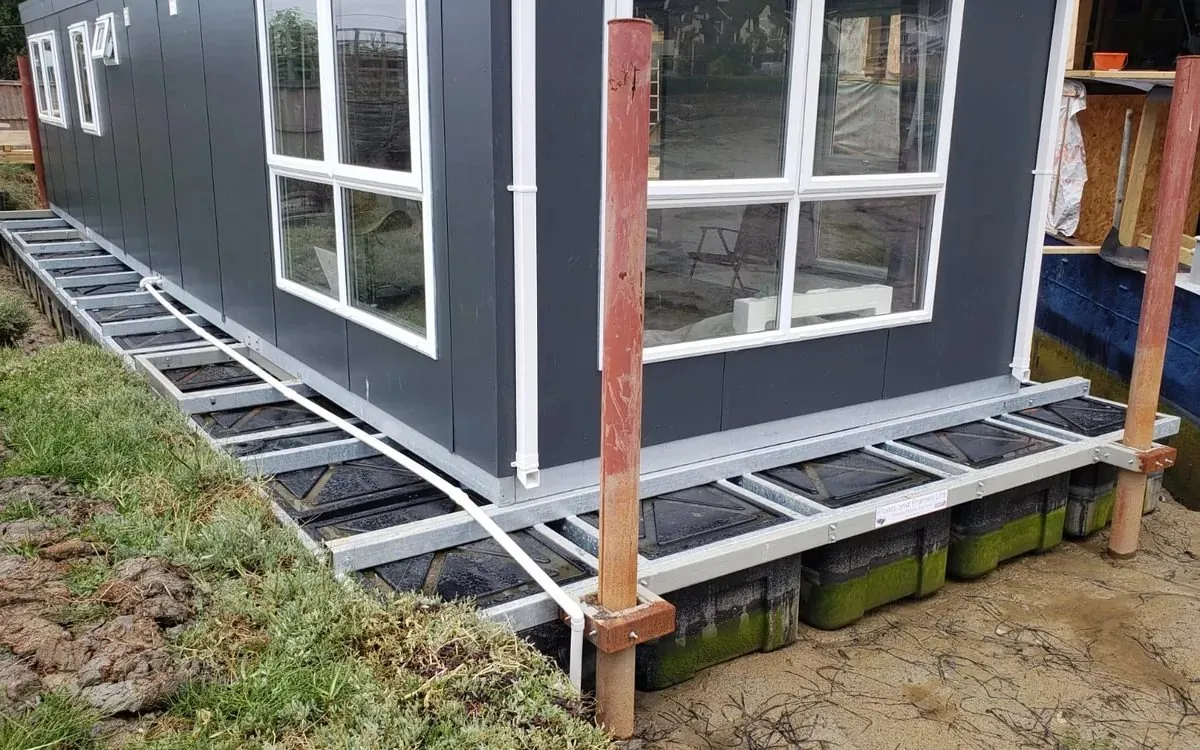
First: which side of the fork is your build on?
The RCR covers watercraft intended for sports and leisure with hull lengths between 2.5 and 24 metres, placed on the market or put into service in the UK. Two consequences for floating home projects:
- A purely static floating home, with no means of propulsion and no intention of navigating, is generally understood to sit outside the definition of a watercraft intended for sports and leisure. The boundary has grey areas and we would not bet a project on it without advice, but static residential platforms are not what these regulations were written for.
- A navigable craft is in scope. If your build can cruise, treat the RCR as applying, whatever you mainly use it for. (Readers of our VAT guide will notice the recurring theme: the navigable and static routes part ways in regulation after regulation.)
The navigable side: the RCR
Pathway 1: the private self-builder
Building for your own use
The RCR excludes watercraft built for own use, provided they are not placed on the market within five years of being put into service. In plain terms: build it yourself, keep it and use it yourself for five years, and the design-and-construction conformity requirements do not apply to you. There is no application to make and no certificate to obtain; the exclusion is automatic. What you should do is keep dated evidence: photographs through the build, invoices, a record of first launch, berthing and insurance documents. The five-year clock and your own-build status are things you may one day need to prove.
None of the exclusion excuses a careless build; it removes a paperwork regime, not the physics. An informed build to recognised good practice is what makes the boat safe, insurable and valuable, and it is exactly where consulting with us on the base, and using the engineered kit system for the structure, puts you a long way ahead.
The kit question, honestly
Here is the nuance most guides skip. The own-use exclusion was written for craft substantially built by the builder, and guidance issued under the equivalent EU regime took the view that assembling a supplied kit does not, by itself, make you the builder of an own-use craft. Where your project sits on that spectrum matters: someone who buys floats and framing components, engineers their own layout and designs and builds their own cabin has a strong claim to be the builder; someone bolting together a complete turnkey package to instructions has a weaker one. This is a genuine grey area, it is argued about in every self-build forum, and we will not pretend it is settled. Our advice: assume the strict reading if you might ever sell early, document the design decisions that are genuinely yours, and take professional advice before relying on the exclusion.
Selling on
After five years of documented own use, an excluded own-build can be sold like any other second-hand boat: normal survey, normal sale.
Within five years, the craft must be brought into conformity before it is placed on the market, and the route is a Post-Construction Assessment (PCA): a surveyor trained by an Approved Body assesses the finished craft and its documentation against the applicable requirements, and the Approved Body issues the certification. Expect it to involve a proper survey, a documentation pack (specifications, drawings, evidence of what is inside the structure), an owner's manual, identification numbering and the appropriate design-category assessment. It is genuinely doable, and it is also genuinely a project; if a sale inside five years is plausible, plan the documentation from day one rather than reconstructing it later.
Pathway 2: professional builders using our system
If you complete and sell craft, you are the manufacturer
Cabin builders, fit-out yards and businesses completing our bases into finished craft for customers take on the manufacturer's role under the RCR, and the obligations that come with it: meeting the essential design and construction requirements (the recognised ISO standards give a presumption of conformity), compiling the technical file, assigning the design category, obtaining a Manufacturer's Identity Code (MIC), which in the UK is administered by British Marine, marking the craft with its Watercraft Identification Number (WIN) and builder's plate, supplying the owner's manual, issuing the Declaration of Conformity and applying the UKCA marking (CE for craft destined for the EU or Northern Ireland).
We support that work seriously: engineering documentation for the base and framing, buoyancy and loading data, material specifications and drawings for what we supply. What we cannot do is discharge the responsibility: the completing builder commissions the vessel, and the conformity of the finished craft belongs to them. If you are building a business on our system, talk to us early and get your compliance advice lined up before the first customer craft, not after.
Design categories, briefly
| Category A | Ocean: designed for extended voyages, significant wave heights above 4 m |
| Category B | Offshore: wind up to force 8, waves up to 4 m |
| Category C | Inshore: coastal waters, large bays, estuaries, lakes and rivers; wind to force 6, waves to 2 m |
| Category D | Sheltered waters: small lakes, rivers and canals; wind to force 4, waves to 0.3 m (occasional 0.5 m) |
Most inland floating home and pontoon projects are Category D territory, with C relevant for estuary and coastal work.
Modifications and conversions
Major modifications and conversions of an existing craft are also within the PCA world: significantly change a craft's structure, propulsion or use and the changes should be assessed and the documentation updated. In the liveaboard world this is honoured unevenly, but it exists, it can surface at survey or insurance time, and buyers of modified craft are entitled to ask where the paperwork is.
The static side: build compliance without the RCR
If your floating home is non-navigable, the RCR steps aside, and people sometimes read that as “no rules”. The truth is different: there is no single statutory building code for floating homes in the UK, so the standards are set by the parties who can say no to you:
- The planning permission and its conditions. As covered in the planning guide, a static residential floating home usually involves the local planning authority, and consents can carry conditions about what is built and how it performs.
- The site or marina operator. Consented floating-home schemes and residential marinas commonly have their own build specifications: dimensions, appearance, services connections, fire separation between neighbouring homes.
- Insurers and lenders. A home that cannot be insured or mortgaged is worth less than it cost to build. Marine and specialist insurers, and the few lenders active in this space, effectively enforce residential build quality through their surveys and questions.
- Good practice, which converges on residential standards anyway. Building Regulations are written for buildings on land and their formal application afloat is grey, but the sensible self-builder borrows their substance regardless: proper insulation, ventilation, safe means of escape, competent gas and electrical installation, and fire-sensible materials. Planners, insurers, lenders and future buyers all ask the same questions, and “built to residential standards” is the answer they are looking for.
The sequencing advice from the planning guide applies doubly here: agree the site's expectations before you build, because a static home cannot cruise away from a specification dispute.
The everyday layer: BSS, gas, electrics and alarms
Separate from both routes above sits the compliance of daily life afloat, and it applies to self-builds with full force:
- Boat Safety Scheme (BSS). The Canal & River Trust, Environment Agency, Broads Authority and most other inland navigation authorities require BSS certification as a condition of licensing, renewed every four years. The examination concentrates on the systems that hurt people: fuel, gas, electrics, heating and ventilation. Authorities differ on how a brand-new craft's first examination is timed and what documentation they accept for it, so ask yours before first licensing rather than assuming.
- Carbon monoxide alarms are mandatory. Since April 2019 the BSS requires certified CO alarms (BS EN 50291), positioned so everyone aboard can hear them, with an alarm in the same space as any solid-fuel stove. Fit them from day one of occupation, not from the first examination.
- Gas deserves professional hands. The BSS examines the LPG installation, and having gas work done by a Gas Safe registered engineer with boat scope is strongly advisable on any liveaboard, and legally required where a craft is rented out or used commercially. Gas is the system where self-build economy is most reliably a false one.
- Electrics. Private boats have no dedicated statutory electrical regime, but the BSS checks the essentials, and the recognised marine standards and codes of practice are what surveyors and insurers expect. Shore-power connections in particular deserve proper design.
- Insurance. Third-party cover is the minimum to license a boat, and insurers of self-builds ask their own questions and may want a survey. Answer them with the documentation you kept during the build; it is the same pack that serves a PCA, a sale or a mooring application.
Where your water changes the picture
| Setting | RCR | BSS & licensing | Who else has a say |
|---|---|---|---|
| Inland waterway (CRT / EA / Broads) | Applies if navigable | Licence + BSS required by the navigation authority | Mooring provider; insurer |
| End-of-garden mooring | Applies if navigable | As for the waterway the garden touches | Navigation authority mooring agreement; insurer |
| Private lake | Applies if navigable (putting into service), but often academic for static platforms | No navigation authority, so no licence or BSS by law; insurers may still want BSS-style survey | Landowner; local planning authority; insurer |
| Coastal / estuary marina | Applies if navigable | BSS is an inland scheme and generally not required; harbour dues and berth conditions instead | Harbour authority; marina berth licence; insurer survey |
| Beaching / tidal drying mooring | As above for the craft | As for the governing water | No extra regime, but hull suitability matters: tell your insurer, and specify floats for beaching duty |
Where we stand, plainly
We supply kits and components: floats, framing, bases and skeletal cabin systems. We do not assemble, complete or commission your vessel, so we are not the manufacturer of the finished craft, and we do not issue its conformity. What you get from us is the part we can stand behind completely: an engineered, documented system with the buoyancy and structural basis your project, and any future assessment of it, will want on paper. Start in the builders below, and talk to the workshop about the compliance shape of your project early; we have watched enough of these builds to know where the paperwork pain lives.
Common questions
Do I need to certify a boat I build for my own use?
Under the Recreational Craft Regulations, watercraft built for your own use are excluded from the design and construction requirements provided they are not placed on the market within five years of being put into service. Keep dated evidence of first launch and use. The exclusion is written for craft substantially built by the builder, and its application to kit-assembled boats is narrower than most people assume, so document your build thoroughly and take advice if you may ever sell.
Can I sell my self-built boat within five years?
Yes, but the craft must then comply with the RCR first, which in practice means a Post-Construction Assessment: a surveyor trained by an Approved Body assesses the craft and its documentation, and the Approved Body issues the certification. After five years of documented own use, an excluded own-build can be sold as an ordinary second-hand vessel.
Does the RCR apply to static floating homes?
The regulations cover watercraft intended for sports and leisure between 2.5 and 24 metres. A purely static floating home with no means of propulsion is generally understood to sit outside that scope, though the boundary has grey areas. A navigable craft that could be used for cruising should be treated as in scope. Confirm your specific position before relying on either reading.
What standards apply to a non-navigable floating home instead?
There is no single statutory building code for floating homes in the UK. In practice the standards are set by the planning permission and its conditions, the site or marina operator's specifications, and what insurers and mortgage lenders will accept, which converges on building to residential standards anyway: insulation, ventilation, safe means of escape, and properly installed gas and electrics. Agree the site's expectations before you build, not after.
Do I need a Boat Safety Scheme certificate for a self-build?
On most inland waterways, yes: the Canal & River Trust, Environment Agency, Broads Authority and most other navigation authorities require BSS certification as a condition of licensing, renewed every four years. The examination focuses on fuel systems, gas, electrics, heating and ventilation, and since April 2019 a certified carbon monoxide alarm is required. Check with your navigation authority about the timing of a new craft's first examination.
What rules cover gas and electrics on a self-build?
Gas is the area to treat most seriously: the BSS examination covers the installation, and having LPG work done by a Gas Safe registered engineer with boat scope is strongly advisable for any liveaboard, and legally required where a craft is rented out or used commercially. Electrics on private boats have no dedicated statutory regime, but the BSS checks the essentials and the recognised marine standards and codes of practice are what surveyors and insurers expect to see.
Who is responsible for compliance when a kit is involved?
Whoever completes and commissions the craft. A kit of floats, framing and components is not a watercraft, so the kit supplier is not the manufacturer of the finished vessel; the person or business that assembles, completes and puts the craft into service takes on that role. A good kit supplier supports that responsibility with engineering documentation, but cannot discharge it for you.
More advice guides
- Planning, Licensing & Mooring Consent: which permissions apply to a floating home, and who to ask
- VAT on Houseboats, Kits & Pontoons: the two zero rates, what they actually cover, and the honest position on kits
- Pontoon Hulls vs Steel vs Concrete: an honest comparison of what your home floats on
Sources & further reading
- The Recreational Craft Regulations 2017 (legislation.gov.uk)
- GOV.UK: Recreational Craft Regulations 2017 guidance
- RYA: home-build boats and craft identification numbers (the own-use exclusion and evidence-keeping)
- Boat Safety Scheme (examination requirements and the CO-alarm rules)
- British Marine (MIC administration and industry guidance)
Checked September 2026. This is the most interpretation-dependent topic we publish on: readings of the own-use exclusion and kit-boat position vary, guidance changes, and nothing here is legal or compliance advice. Confirm your project's position with British Marine, the official guidance or a marine surveyor before committing.